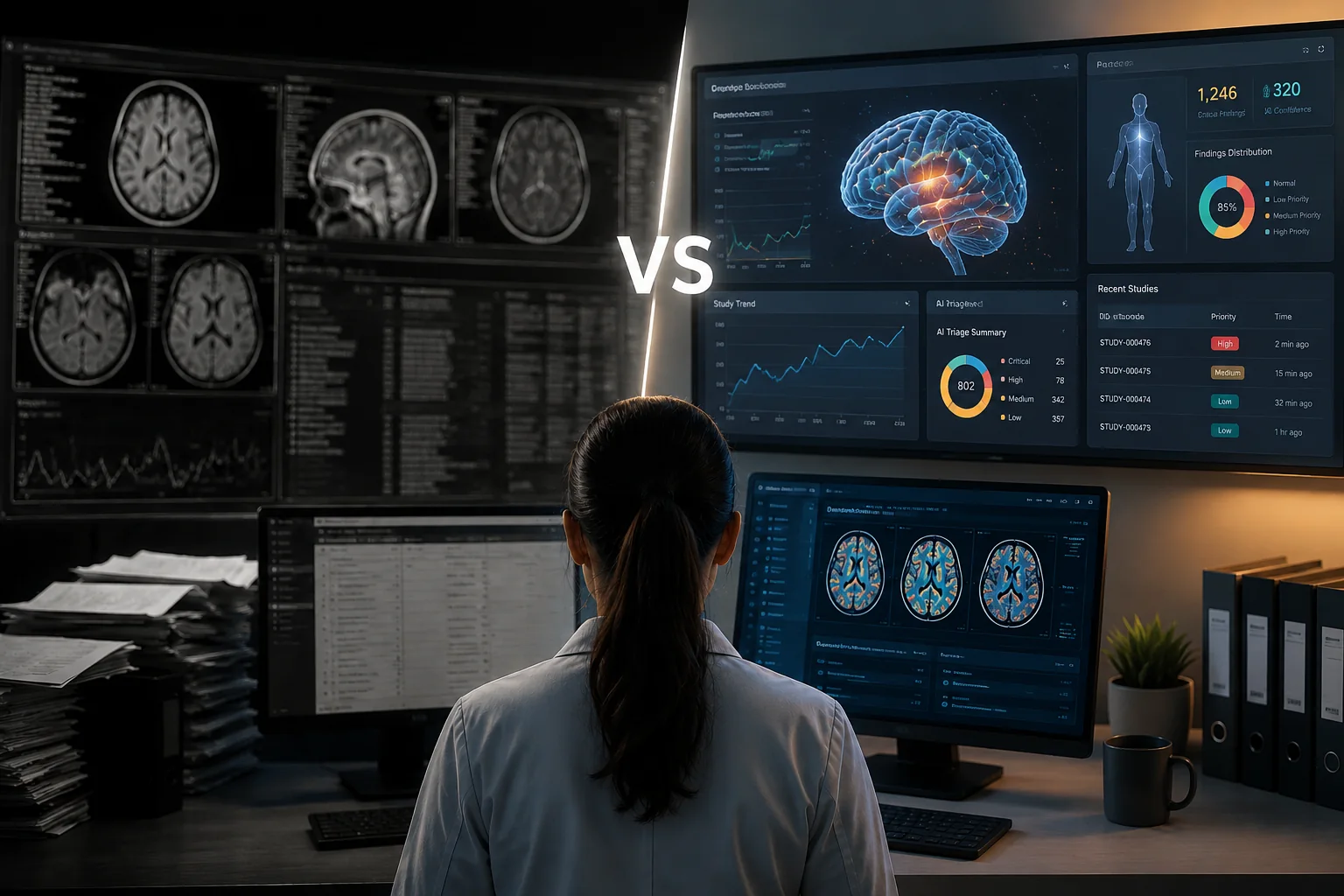
The conversation around AI in clinical imaging has reached an inflection point. While early adopters focused on automating isolated tasks — flagging image quality issues, measuring tumors, generating reports — the real transformation is happening at a different level entirely. The question is no longer whether AI can handle specific imaging tasks, but whether it can fundamentally redesign how clinical imaging operations function within regulated research.
This is the distinction between automation and intelligence. Automation replaces manual steps. Intelligence redesigns the entire workflow around better decision-making, predictive capability, and adaptive execution. For sponsors and CROs managing imaging endpoints in 2026, understanding this difference is critical to competitive advantage.
What Is AI in Clinical Imaging?
AI in clinical imaging encompasses machine learning models, computer vision algorithms, and intelligent orchestration systems designed to support medical image acquisition, analysis, quality assurance, and endpoint assessment in clinical trials. Unlike AI tools built for diagnostic radiology in clinical care, these systems operate under the regulatory constraints of Good Clinical Practice (GCP), 21 CFR Part 11 compliance, and protocol-specific acceptance criteria that vary across trials.
The technology stack typically includes:
- Computer vision models trained to detect anatomical structures, identify imaging artifacts, verify protocol compliance, and flag quality issues
- Natural language processing for extracting structured data from radiology reports and clinical narratives
- Workflow orchestration engines that route cases, manage reader assignments, trigger adjudication, and maintain audit trails
- Predictive analytics that forecast enrolment feasibility, identify sites at risk for protocol deviations, and optimize resource allocation
Critically, these systems are designed to augment, not replace, credentialed radiologists and clinical operations teams. The goal is not autonomous decision-making but rather intelligent assistance that allows human experts to operate at higher velocity and greater consistency.
The Evolution of AI in Clinical Research Imaging
The application of AI to clinical imaging has progressed through three distinct phases, each building on the limitations of the previous generation.
Phase 1: Task-Specific Automation (2015–2020)
Early implementations focused on narrow, well-defined tasks: automated lung nodule detection, tumor segmentation, and bone age assessment. These tools operated in isolation, requiring manual handoffs before and after the AI step. They delivered value in specific use cases but did not integrate into broader trial workflows. Radiologists treated them as decision support tools — helpful but not transformative.
The limitation of this phase was fragmentation. Each AI tool solved one problem but created integration challenges. Data had to be manually moved between systems. Audit trails were disconnected. And the overall workflow remained as manual as before, with AI functioning as an optional add-on rather than a core operational capability.
Phase 2: Workflow Integration (2020–2024)
The second wave brought AI into the operational layer. Systems began handling case routing, quality control checks, and structured data capture. Instead of standalone algorithms, AI became embedded in imaging platforms that connected to PACS, EDC systems, and project management tools. The focus shifted from “Can AI detect X?” to “Can AI make the entire imaging operation more efficient?”
This phase delivered measurable operational gains — faster turnaround times, fewer manual errors, better resource utilization — but remained largely reactive. AI responded to cases as they arrived rather than anticipating problems or optimizing across the trial lifecycle. The workflow was still predefined; AI simply executed it more efficiently.
Phase 3: Intelligent Orchestration (2024–Present)
The current generation treats AI as the orchestration layer for the entire imaging program. Rather than automating tasks within a fixed workflow, the system continuously optimizes the workflow itself based on real-time performance data, protocol requirements, and resource constraints. This means:
- Predictive site selection based on historical imaging protocol feasibility
- Adaptive quality thresholds that tighten or relax based on downstream read requirements
- Dynamic reader assignment that balances workload, expertise, and turnaround targets in real time
- Proactive deviation prevention through early warning systems that flag sites before problems compound
This is the shift from automation to intelligence. The platform doesn’t just execute predefined steps faster — it learns, adapts, and optimizes continuously. This is what platforms like ONIX AI™ deliver: not just faster execution of manual processes, but fundamentally redesigned workflows that were impossible without intelligent orchestration.
The Technical Architecture of AI-Native Imaging Platforms
Understanding how AI-native platforms differ from legacy systems requires looking at the underlying architecture. The distinction is not about whether AI is present, but where it sits in the technology stack.
Legacy Architecture: AI as a Feature
Traditional imaging CROs built their systems as service delivery platforms: PACS for storage, spreadsheets for tracking, email for communication, separate portals for reporting. When AI arrived, it was added as a feature — an image quality checker here, a measurement tool there — without changing the core architecture.
The result is a patchwork: AI outputs must be manually reviewed, transcribed, and moved between systems. The audit trail is fragmented. The workflow remains rigid. And when a protocol requires customization, it requires engineering work rather than configuration.
This approach delivers incremental improvements but leaves fundamental inefficiencies intact. The operational model remains manual-first, with AI providing assistance at specific touch points rather than driving the entire workflow.
AI-Native Architecture: Intelligence as the Foundation
AI-native platforms invert this model. The workflow engine itself is driven by machine learning models that continuously evaluate case characteristics, reader performance, protocol requirements, and operational constraints to make routing, prioritization, and quality decisions. Key architectural differences include:
- Protocol as Configuration: Instead of hardcoding workflows, the protocol document becomes a machine-readable configuration file that defines acceptance criteria, read requirements, adjudication rules, and data structures. Changes to the protocol update the system behavior automatically without custom development.
- Event-Driven Orchestration: Every action — image upload, QC check, reader assignment, report submission — triggers the next step automatically based on protocol logic and current system state. There are no manual handoffs or batch processes waiting for human intervention.
- Unified Data Model: All imaging data, metadata, findings, and audit events are stored in a single relational database with full version control. This eliminates the fragmentation that creates compliance risk and enables real-time analytics across the entire imaging program.
- API-First Integration: The platform exposes all functionality through APIs, enabling seamless integration with EDC systems, CTMS platforms, and sponsor data warehouses. Structured data flows automatically rather than requiring manual export and import cycles.
This architecture enables the platform to scale across hundreds of concurrent trials without proportional increases in operational overhead — a fundamental economic advantage over legacy service models. It is this architectural foundation that makes faster, more consistent read turnaround possible.
Regulatory Considerations and Validation Requirements
AI tools used in clinical trials operate in a regulated environment. While they do not require FDA approval in the same way that diagnostic AI devices do, they must be validated for their intended use and documented appropriately in regulatory submissions.
Key Validation Requirements
- Algorithm Performance Documentation: Training data provenance, model architecture, performance metrics (sensitivity, specificity, accuracy) on independent validation sets, and edge case handling. Sponsors need to understand how the AI model was developed, what data it was trained on, and how it performs across different imaging modalities and patient populations.
- Version Control and Change Management: Procedures for tracking model versions, documenting changes, and revalidating when algorithms are updated. This is critical for maintaining consistency across the trial lifecycle. If an AI model is updated mid-trial, there must be a clear audit trail showing what changed, why, and how the new version was validated.
- Audit Trail Completeness: Demonstration that every AI-generated output (QC flag, case assignment, structured data field) is logged with timestamp, attribution, and traceability to source data. This is where 21 CFR Part 11 compliance becomes non-negotiable. Every decision the AI makes must be traceable, and every action must be attributable to a specific user or system process.
- Human Oversight Mechanisms: Documentation of how human reviewers validate, override, or approve AI-generated outputs before they become part of the trial record. This is the foundation of human-in-the-loop governance, ensuring that AI augments rather than replaces clinical judgment.
Practical Implications for Trial Sponsors
Sponsors should expect imaging partners to provide validation documentation as part of trial setup and to maintain validated, version-controlled AI models that can be audited during regulatory inspections. This documentation should include:
- Model validation reports with performance metrics
- Standard operating procedures for AI model deployment and monitoring
- Change control procedures for model updates
- Training records for staff using AI-assisted workflows
- Audit trail examples demonstrating full traceability
The regulatory landscape for AI in clinical trials is evolving, but the core principle remains constant: technology must enhance, not obscure, the integrity and traceability of clinical data.
Conclusion: Understanding the New Landscape
AI in clinical imaging has moved beyond the experimental phase. The technology exists, the regulatory framework supports it, and early adopters are demonstrating measurable operational advantages. But not all AI implementations are created equal.
The critical distinction is between AI as a feature and AI as infrastructure. Legacy imaging CROs are adding AI capabilities to existing manual workflows, delivering incremental improvements. AI-native platforms are rebuilding workflows from the ground up with intelligence as the foundation, delivering transformational change.
For sponsors and CROs evaluating imaging partners in 2026, the key questions are architectural:
- Is AI embedded in the workflow engine or bolted onto legacy systems?
- Does the platform learn and adapt, or simply execute faster?
- Is the audit trail unified and immutable, or fragmented across systems?
- Can protocols be configured rather than custom-coded?
The answers to these questions determine whether an imaging partner can deliver the speed, scale, and compliance that modern trials demand — or whether they’re simply rebranding legacy operations with AI marketing.
Ready to explore how AI-native platforms work in practice?
Learn more about ONIX AI™ or talk to our clinical team about your imaging program.
Explore ONIX AI™ Contact Our Clinical TeamFrequently Asked Questions
What is AI in clinical imaging?
AI in clinical imaging refers to machine learning algorithms and intelligent orchestration systems designed to support image acquisition, quality control, interpretation, and endpoint management in clinical trials. These systems operate within GCP and 21 CFR Part 11 compliance frameworks and are designed to augment rather than replace credentialed radiologists.
How is AI in clinical imaging different from diagnostic AI used in hospitals?
Diagnostic AI is designed for clinical care and focuses on detecting diseases or abnormalities to support patient treatment decisions. AI in clinical imaging is purpose-built for regulated research, operating under protocol-specific acceptance criteria and emphasizing audit trails, structured data capture, and workflow orchestration rather than autonomous diagnosis.
What are the three phases of AI evolution in clinical imaging?
Phase 1 (2015–2020) focused on task-specific automation like tumor segmentation. Phase 2 (2020–2024) integrated AI into workflows for case routing and QC. Phase 3 (2024–present) uses AI as the orchestration layer that continuously optimizes workflows based on real-time data and learns from outcomes.
What does “AI-native” mean in the context of clinical imaging platforms?
AI-native platforms are built from the ground up with AI as the core orchestration layer, where machine learning models drive workflow decisions, case routing, and quality control. This differs from “AI bolt-on” approaches where AI features are added to existing legacy systems without changing the underlying architecture.
Do AI tools used in clinical trials require FDA approval?
AI tools used in clinical trials do not require FDA approval in the same way that diagnostic AI devices do, but they must be validated for their intended use and documented appropriately in regulatory submissions. Validation documentation should include training data provenance, performance metrics, version control procedures, and audit trail completeness.
What is 21 CFR Part 11 compliance and why does it matter for AI in clinical imaging?
21 CFR Part 11 is the FDA regulation governing electronic records and electronic signatures in clinical trials. For AI in clinical imaging, this means every AI-generated output must be logged with timestamps, attribution, and traceability to source data in an immutable audit trail that can withstand regulatory inspection.
Can AI replace radiologists in clinical trials?
No. AI in clinical research is designed to augment, not replace, radiologists. Clinicians retain full accountability for medical interpretation and endpoint assessment. AI handles operational tasks — routing, QC flagging, data structuring — while radiologists focus on clinical judgment and protocol compliance.
What is “protocol as configuration” in AI-native platforms?
Protocol as configuration means the clinical trial protocol becomes a machine-readable file that automatically defines the system’s behavior — acceptance criteria, read requirements, adjudication rules, and data structures. This eliminates custom coding for each trial and allows protocol changes to update system behavior automatically.
How do I know if an imaging CRO is truly AI-native or just using AI marketing buzzwords?
Ask specific architectural questions: Is AI embedded in the workflow engine or added as a feature? Can protocols be configured or do they require custom development? Is there a unified audit trail or fragmented logs? Request demonstrations of intelligent case routing, pre-read QC, and structured data integration in action.
What should I look for in AI validation documentation from an imaging partner?
Look for model validation reports with performance metrics on independent datasets, standard operating procedures for AI deployment and monitoring, change control procedures for model updates, training records for staff, and audit trail examples demonstrating full traceability of AI-generated outputs.
Continue to Part II: Strategic Use Cases and Economic Impact
Explore where AI delivers measurable impact, the economics of AI-native vs. legacy imaging operations, and a practical implementation roadmap.
Read Part II